The Invisible Structural Damage Risk: Remanufactured Mitsubishi L 400 Engine Specifications Checked
June 29, 2026
'Fully Reconditioned' Means Absolutely Nothing: The Exact Tolerance Sheet and Process Required to Save Your Car
When a supplier advertises a used engine for sale, replacement engine price, or reconditioned engines near me for your Mitsubishi L400, the term “fully reconditioned” is legally and technically meaningless without documented process data. A genuine remanufactured Mitsubishi L 400 Engine (typically the 4D56 or 4D56T diesel) demands measurable structural restoration to OEM tolerances — not a superficial clean-up.
Why Does 'Fully Reconditioned' Mean Nothing When Applied to a Used Engine for Sale Without Supporting Documentation?
Under UK Trading Standards and the Consumer Rights Act 2015, terms like “reconditioned,” “rebuilt,” or “remanufactured” have no statutory definition. A seller must prove the goods are of satisfactory quality, fit for purpose, and match the description. Vague claims fail this test when challenged.
The absence of a detailed rebuild record and post-build test sheet leaves you with no recourse under the CRA 2015. Demand the full process log and test data before purchase — if they cannot provide it, walk away. You can require evidence post-sale if issues arise within the reasonable period.
What Does a Genuine Remanufacture of a Remanufactured Mitsubishi L 400 Engine Actually Involve - The Complete Step-by-Step Process?
A true remanufacture of the Mitsubishi L400’s 4D56-series engine restores it to OEM structural integrity through controlled, measurable processes. This far exceeds a typical “reconditioned” or used engine offering.
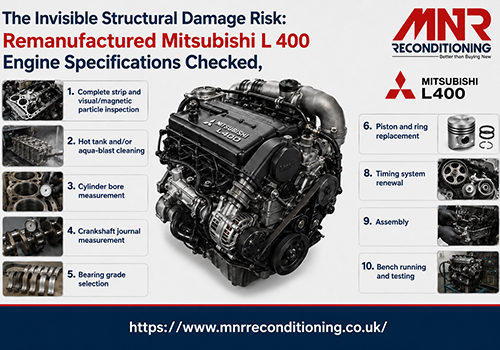
Here is the 10-step process:
- Complete strip and visual/magnetic particle inspection of block, head, crank, and rods against OEM tolerance data.
- Hot tank and/or aqua-blast cleaning followed by pressure testing for cracks in block and head.
- Cylinder bore measurement (standard 91.1 mm); decision to hone or re-bore based on wear, taper, and out-of-round (limit typically <0.02 mm).
- Crankshaft journal measurement (main and rod) to OEM specs; re-grind if out of tolerance (typical main journal ~60-65 mm range depending on exact variant; end-float controlled).
- Bearing grade selection and fitting to achieve specified oil clearance (typically 0.02–0.05 mm for rods/mains in these diesels).
- Piston and ring replacement as standard (new oversize if bored); piston-to-wall clearance restored to ~0.03–0.07 mm.
- Cylinder head rebuild: valve seat cutting, guide replacement, stem seals, resurfacing, and pressure testing.
- Timing system renewal: timing belt, tensioners, and balance shaft components replaced as standard (common failure point).
- Assembly using OEM torque sequences and specifications, with new gaskets, seals, and fasteners where required.
- Bench running and testing: hot and cold parameters including compression, oil pressure, leak-down, and power output verification.
Rebuild Standards Comparison:
|
Process Step |
Used Engine |
Reconditioned |
Remanufactured |
|
Full disassembly & inspection |
~ |
✓ |
✓ |
|
Crack/pressure testing |
✗ |
~ |
✓ |
|
Bore measurement & hone/bore |
✗ |
~ |
✓ |
|
Crank journal regrind |
✗ |
~ |
✓ (as needed) |
|
New pistons/rings standard |
✗ |
~ |
✓ |
|
Head valve/seat full rebuild |
✗ |
~ |
✓ |
|
Timing components (belt etc.) |
✗ |
~ |
✓ |
|
Bench test with data sheet |
✗ |
~ |
✓ |
|
Documented tolerances |
✗ |
✗ |
✓ |
Many “reconditioned” L400 engines skip structural checks like crank straightness or head pressure testing, leading to premature failure under load.
What Should a Remanufactured Mitsubishi L 400 Engine's Post-Build Test Sheet Show - and What Does Its Absence Actually Mean?
A legitimate test sheet for a replacement Mitsubishi L 400 Engine includes:
- Compression test: typically 380–450+ psi per cylinder (cold/hot), with <10% variance between cylinders.
- Oil pressure: minimum ~1.0–1.5 bar at idle hot, rising appropriately with RPM.
- Leak-down test results showing low leakage percentages, confirming valve and ring sealing beyond what compression testing alone reveals.
The Test Sheet Challenge: Ask any supplier for the post-build test sheet with actual measured values. If they don’t have one, the engine was never properly tested to verifiable standards. Absence of this data is a strong indicator of superficial work.
A good leak-down test exposes issues (such as valve seating or ring sealing) that a basic compression test misses, especially in turbo diesels prone to head gasket and cracking problems.
What Is the Exact Remanufactured Mitsubishi L 400 Engine Code, Chassis Match, and Ancillary Variant - and Why Does Getting This Wrong Destroy the Rebuild?
The primary engine for the L400 (Delica) is the 4D56 (2.5L diesel, bore 91.1 mm × stroke 95 mm, compression 21:1). Variants include turbo (4D56T) and non-turbo. Match to chassis code (e.g., PA5V series) and ancillary equipment: injection pump, turbo, intercooler, and wiring/ECU.
Mismatching turbo vs non-turbo or injection systems creates boost/oil pressure mismatches that destroy tolerances achieved during rebuild. DVSA emissions compliance and ULEZ status depend on the correct variant — incorrect fitment risks failure on test.
Fitting the wrong ancillary variant (e.g., mismatched turbo) often voids any performance or longevity claims and can lead to immediate structural stress.
Why Do 4D56 Head Gaskets and Timing Systems Fail Repeatedly in L400 Engines - and How Is This Addressed in a Proper Remanufacture?
The 4D56 in L400 applications is notorious for head gasket failures and cracking, often linked to overheating, and balance shaft/timing belt issues that cascade into valve and piston damage.
A proper remanufacture addresses this with full head resurfacing/pressure testing, upgraded or OEM-equivalent multi-layer steel gaskets where applicable, complete timing belt kit replacement (including tensioners and balance shaft components), and verification of cooling system passages.
Skipping the balance shaft belt or using low-grade timing components is a false economy — it frequently leads to belt failure and catastrophic engine damage.
What ULEZ and MOT Emissions Compliance Looks Like After a Remanufactured Mitsubishi L 400 Engine Swap?
A correctly remanufactured 4D56 to OEM tolerances, with proper injection timing, new injectors/glow plugs, and EGR/intake cleaning, passes MOT emissions and maintains ULEZ compliance for eligible L400 variants. Post-rebuild calibration of pump timing and verification of smoke opacity are essential.
Cold-start performance in UK conditions requires correct bearing clearances and oil grade to minimise wear. Road salt protection involves treating external machined surfaces.
Explore More About Mitsubishi Engines
- 1 - Real Cost Breakdown: Used Mitsubishi Shogun Engine vs Full Engine Supply and Fitting in the UK
- 2 - Top Signs of a Good Used Mitsubishi L400 Engine: Inspection Tips for Buyers
- 3 - How to Choose Reliable and Efficient Mitsubishi L200 Engines for Your Vehicle
- 4 - Mitsubishi Shogun Used Engines: A Cost-Effective Solution for Your Vehicle
People Also Ask
How much does a reconditioned Mitsubishi L400 engine cost?
A properly remanufactured unit with full documentation and test sheet typically commands a premium over vague “used engine for sale” or basic reconditioned options because of the verifiable tolerances and replaced components. Expect the price to reflect new pistons, bearings, timing components, and machining as needed.
What is the difference between a used and remanufactured Mitsubishi L400 engine?
A used engine is pulled and possibly run-tested with no structural work. A remanufactured one follows the full tolerance-controlled process above, replacing wear items as standard and documenting results.
How long does a remanufactured 4D56 engine last in an L400?
With documented rebuild to OEM tolerances and proper maintenance, these can exceed original service life. Key factors are cooling system integrity and timing belt changes.
What compression should a healthy remanufactured L400 diesel show?
Around 380–450+ psi per cylinder with minimal variance, verified on the test sheet.
Do I need to replace the timing belt during L400 engine replacement?
Yes — as standard in a proper remanufacture. The 4D56 timing and balance systems are high-wear items.
What are the main tolerances checked in a 4D56 rebuild?
Cylinder bore (91.1 mm standard), piston-to-wall (~0.03–0.07 mm), crank journal clearances (0.02–0.05 mm typical), and crank end-float.
How can I verify a supplier's claims for a replacement Mitsubishi L400 engine?
Demand the full process record, tolerance measurements, and signed test sheet. Absence of these is a red flag.
'Fully reconditioned' means nothing without this level of transparency. We show you exactly what was done — and prove it with measurable data.
Contact us today for your Remanufactured Mitsubishi L 400 Engine with the full tolerance sheet and test data included. Specify your chassis and variant for the correct match.
Written by George Robinson | Dedicated ET Automotive Writer & Mechanic.Categories
- Reconditioned Engines
- Land Rover
- BMW
- Saloon
- Mitsubishi
- Jaguar
- Infotainment System
- Mitsubishi
- Ford
- Fiat Ducato
- Ford Mondeo
- Citroen
- Mazda
- Ford Ranger
- Peugeot
- Cylinder Head
- Info-graphics
- Reconditioned Engine
- Engine Pistons
- Blown Head Gasket
- Engine Boring
- Engine Replacement
- Machine Shop
- Engine Surface Treatment
- Crankshaft Bearing Coatings
- Engine Degreasing
- Connecting Rod Crack
- Engine Connecting Rods
- Engine Valve Grinding
- Engine Block Liners
- Crankshaft Crack
- Crankshaft Polishing
- Crankshaft Balancing
- Crankshaft Grinding
- Nissan
- Valve Lapping